
Mariposa County Sex Offender Checks
The California Megan's Law Website is the main public source for a Mariposa County sex offender lookup. California DOJ manages it and law-enforcement agencies update registry information daily. It supports both identity and place-based searches. A name is useful when the person is known. An address, ZIP code, community, radius, or Mariposa County filter is better for neighborhood awareness.
The registry is not a full criminal-history database. It covers people and offenses subject to public registration rules, while excluding unrelated arrests and convictions. Mariposa County does not publish a separate local registry map. The Sheriff's Office is the practical local contact for registration questions and suspected failures to comply. Use 911 only for an immediate threat.
Mariposa Registry Updates Each Day
The California state service page says law enforcement updates the registered sex offender database daily. That does not mean every life event appears at once. A profile reflects data provided under the registration system, and public visibility depends on Penal Code rules. Confirm a safety concern with the Sheriff's Office rather than drawing conclusions from an old screenshot or a third-party list.
The official state page identifies California DOJ as the registry manager and lists 800-952-5225 for state service questions. This is also why official pages should take priority over copied directories. The official record can change as agencies submit updates.
A source view of the state registry service is shown below.
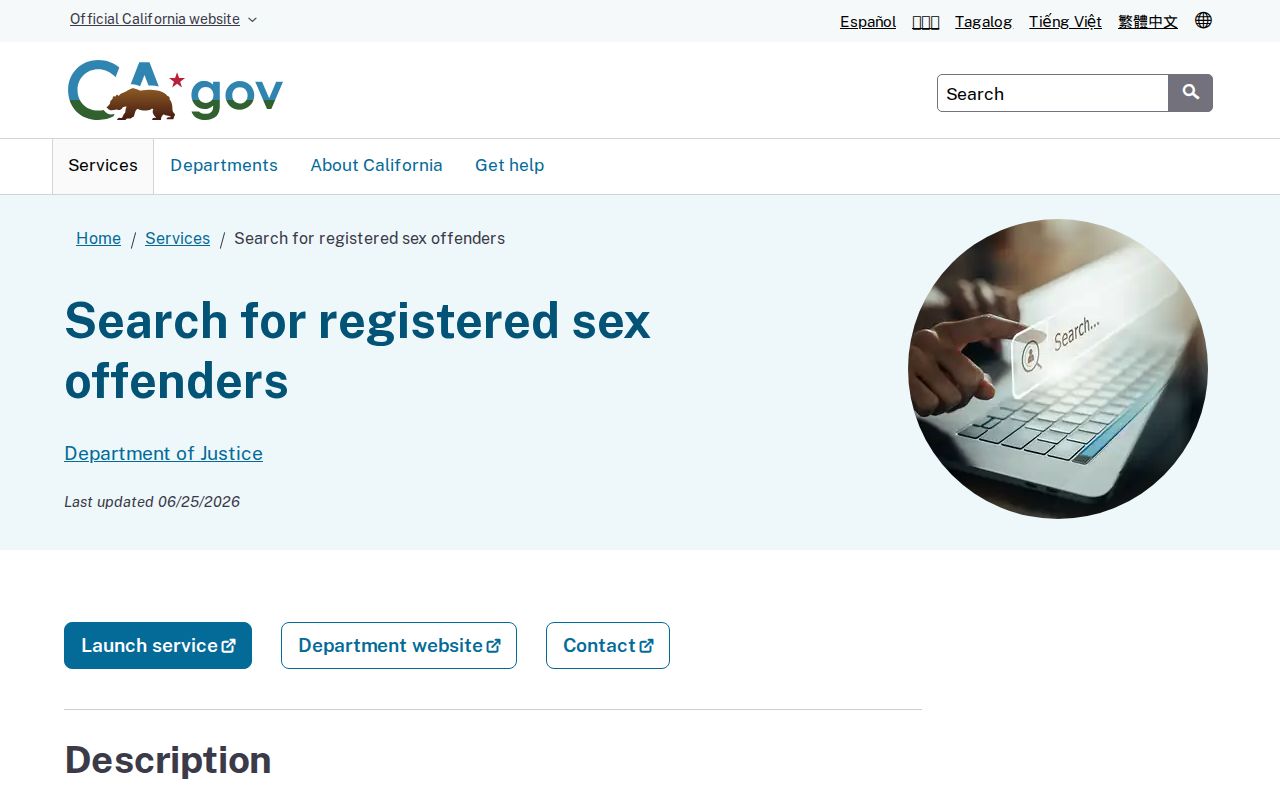
The state description confirms both the public purpose and the daily law-enforcement update cycle.
Search California Megan's Law
Open the official registry and read its conditions before searching. The warning matters because California limits how disclosed information may be used. Search terms can be broad in rural Mariposa County, so start with the strongest known detail and then widen the query. Spelling variants and nearby ZIP codes can help when a name or community search returns no clear match.
- Open California Megan's Law and accept the conditions of use.
- Search by name, or choose an address, ZIP, community, radius, or Mariposa County filter.
- Compare the result list by photograph and physical details. Do not rely on a shared name alone.
- Open the profile and read the offense, location disclosure, risk, and status fields in context.
| Field Label | Type | Required | Notes |
|---|---|---|---|
| Name | Text | No | Try first and last name plus spelling variants. |
| Address | Address | No | Find publicly listed registrants near a location. |
| Community / ZIP | Text or select | No | Use Mariposa, Lake Don Pedro, Greeley Hill, or a ZIP code. |
| County | Select | No | Select Mariposa for a countywide result set. |
| Radius / map | Map control | No | Use geographic results where the interface offers them. |
No City Police Registry Office
Mariposa County has no incorporated cities and no city police departments were found. Mariposa, Lake Don Pedro, and Greeley Hill are census-designated or unincorporated communities. Penal Code section 290 directs a registrant to the sheriff when the residence is outside a city police jurisdiction. As a result, local registration questions for these communities route to the Mariposa County Sheriff's Office, not to a fictional city records desk.
The Sheriff's Office is at 5099 Old Highway Road, Mariposa, and its main phone is 209-966-3615. Research did not locate published registration hours or a local fee schedule. Call before visiting for current appointment instructions. This local office does not replace the public state search.
The official Megan's Law search interface provides the public entry point.
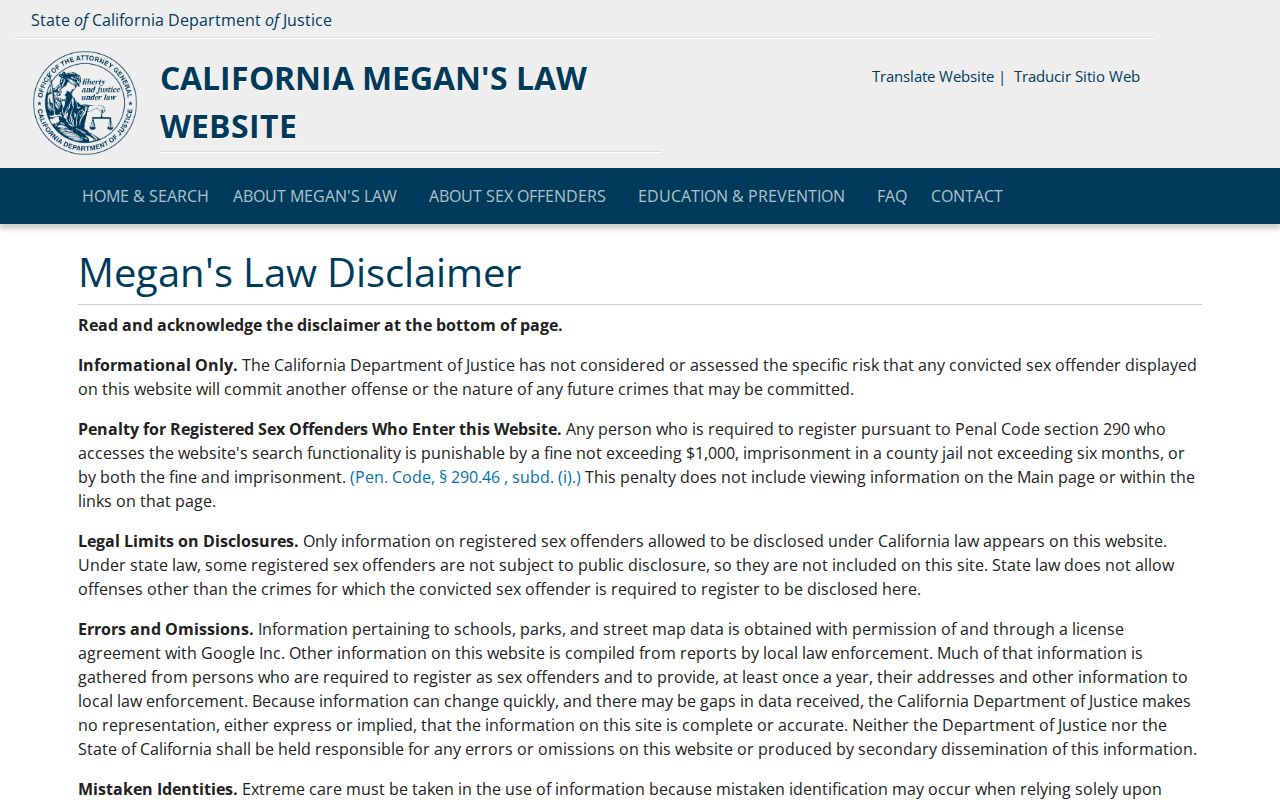
Its disclaimer gate reinforces that the search comes with legal conditions.
What Mariposa Registry Profiles Show
A public profile helps distinguish one person from another and describes the registerable offense history that the statute permits DOJ to disclose. It may show an exact address for some categories and only a community, ZIP code, or county for others. That difference is a legal feature, not proof that a record is incomplete. Victim details, employer information, non-registerable history, and some juvenile information remain excluded.
| Name & Aliases | Public identity fields and known aliases. |
|---|---|
| Photo & Description | Photograph, sex, race, height, weight, hair, eyes, and identifying marks when available. |
| Location | Exact address for categories made public; otherwise community, ZIP, or county. |
| Offense History | Registerable offenses, plus conviction and release years when required data is available. |
| Risk Information | SARATSO static risk or elevated-risk data when available. |
| Status | Registration or compliance information when displayed. |
Cross State Checks Through NSOPW
The National Sex Offender Public Website adds a cross-state layer. It is useful when a person recently moved, an address sits near a county or state boundary, or a searcher does not know which jurisdiction holds the listing. NSOPW queries participating public registries, while California Megan's Law remains the best place to interpret a California profile and its disclosure rules.
Use both tools with the same care. Match more than a name, review the source jurisdiction, and follow the profile back to the official registry. NSOPW does not turn registry data into a complete nationwide criminal-history report.
The official NSOPW search is pictured here.
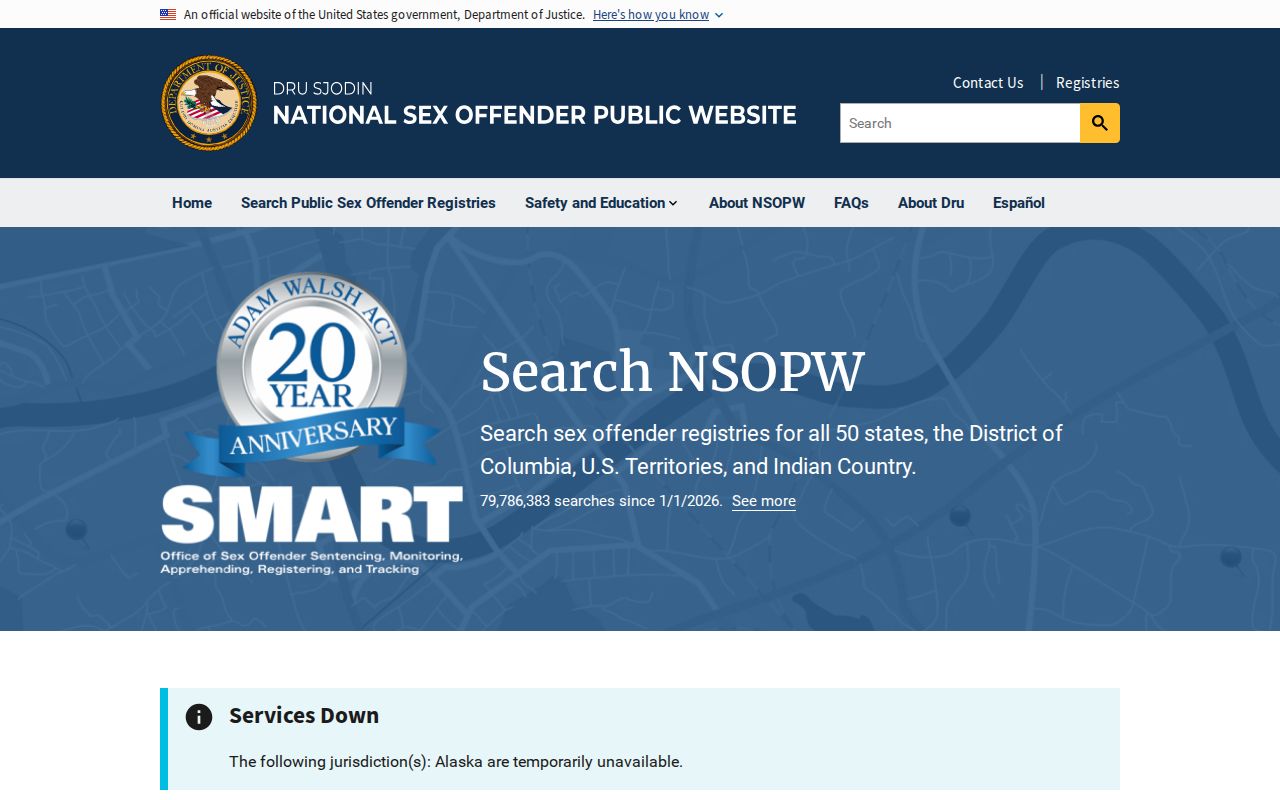
The national tool complements, but does not replace, California's profile details.
California Registration Tiers
Penal Code section 290 sets California's registration framework. Tiers establish a minimum registration period, but the statute contains detailed offense, risk, and repeat-offense rules. A tier is not a simple score of present danger. Nor does reaching a minimum period guarantee that a public listing vanishes automatically. Legal status depends on the governing process and current record.
| Tier | Minimum period | General summary |
|---|---|---|
| Tier one | 10 years | Generally specified misdemeanor and non-serious, non-violent felony registerable offenses unless a higher tier applies. |
| Tier two | 20 years | Certain serious, violent, specified, or repeat registerable offenses. |
| Tier three | Life | Specified serious or violent offenses, repeat offenses, SVP-related status, and other statutory categories. |
Mariposa Tier Rules at Source
Read tier language from the current statute rather than a commercial summary. The law is dense because classification can turn on offense details and prior history. The source image below comes from Penal Code section 290.
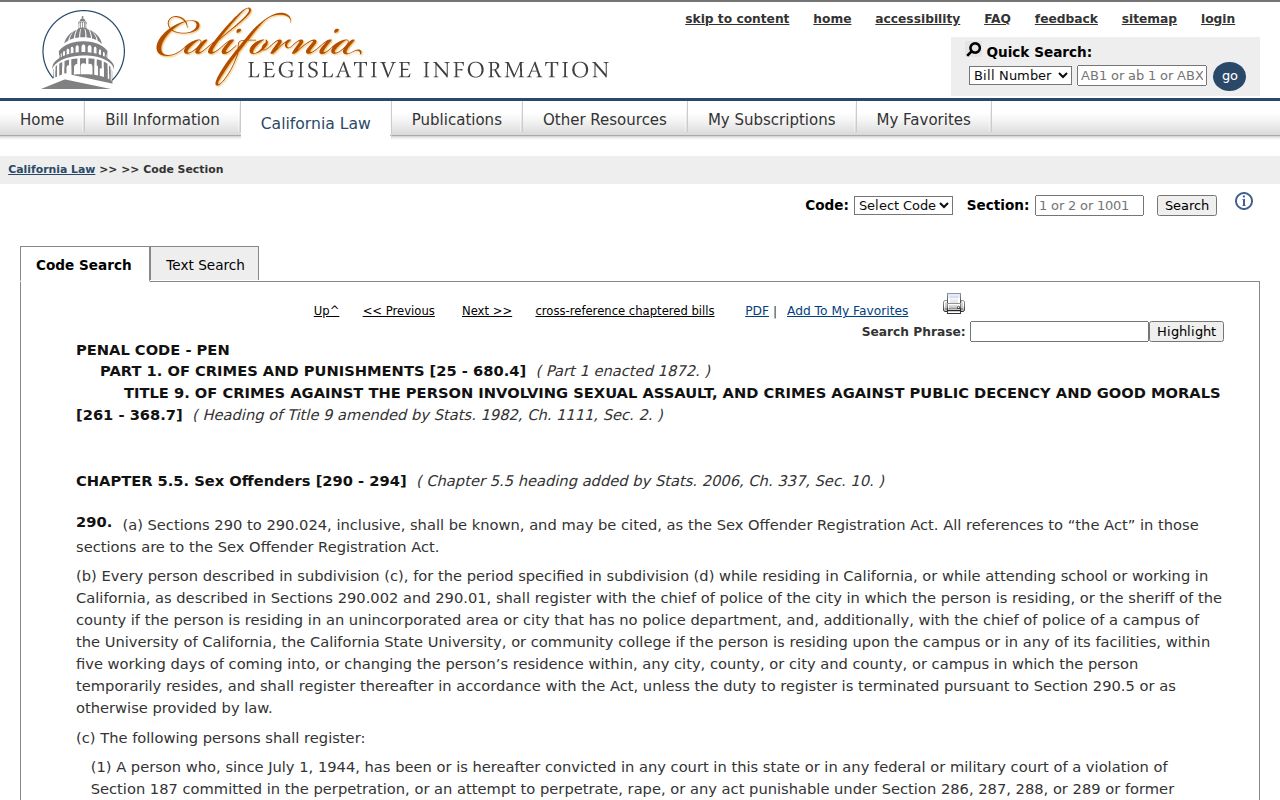
For a question about one person's duty or petition eligibility, the statute and official case record matter more than a broad tier label.
Why Mariposa Addresses Differ
Penal Code section 290.46 controls the public website and the information it may disclose. Some profiles can show a full residence address. Others show a community of residence and ZIP code, or county-level information. Transient status can also change how location appears. A map pin should never be read as a promise that a person is at that spot at a given moment.
The same section protects victim identity and excludes employer names and addresses. It also keeps non-registerable criminal history outside the public registry profile. Those exclusions help explain why Megan's Law should not be used as a substitute for a Mariposa Superior Court case search or a person's official DOJ self-review.
The official public-disclosure statute is shown below.
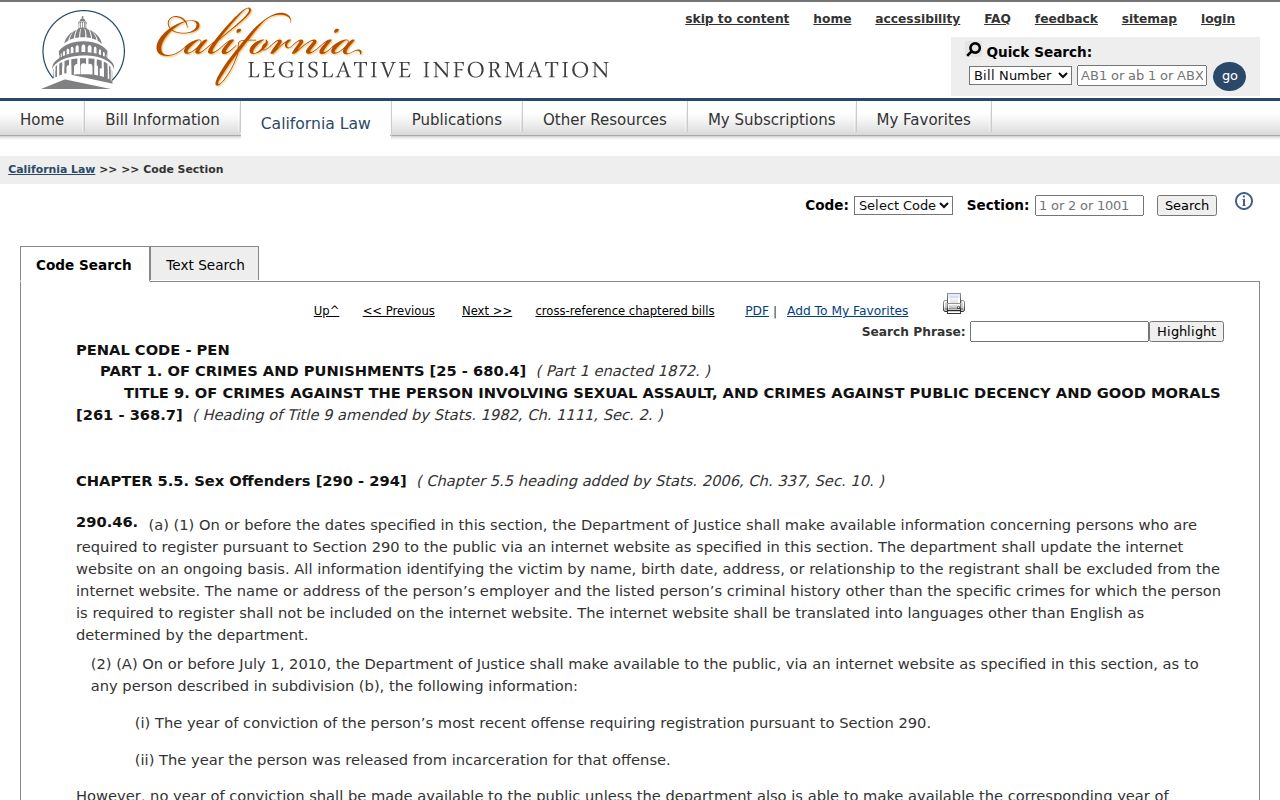
It defines both disclosure boundaries and consequences for misuse.
Match Mariposa Registry Identities
A shared name is not enough to identify a person. Compare the official photograph, aliases, physical description, age-related field, scars or tattoos, disclosed location, and registerable offense history. A profile can also include the year of conviction and release for the most recent registerable offense when DOJ has the required information. These fields help prevent a searcher from attaching one person's registry record to someone else with a similar name.
Location data requires the same care. An exact address may be public for one statutory category while another profile gives only a ZIP code, community, or county. A transient listing may not point to a conventional residence. Search nearby Mariposa County communities and ZIP codes when the known location is uncertain, but do not treat a radius result as proof that a person is present at a mapped point. The profile states registry information, not live movement.
If a record seems inconsistent, use the official site rather than a saved image or commercial copy. California's daily update process can make an old capture stale. Contact DOJ about website issues and the Mariposa County Sheriff's Office about a credible local compliance concern. Do not confront the listed person or household. Law enforcement can compare the public display with registration information that is not open to general inspection.
Lawful Mariposa Community Use
The public registry supports awareness and protection of a person at risk. Use the official result to make calm safety plans and contact law enforcement about credible noncompliance. For a suspected registration violation in an unincorporated Mariposa County community, call the Sheriff's Office at 209-966-3615. Call 911 when danger is immediate. DOJ handles website and statewide registry questions.
California law bars many unrelated uses of registry data and imposes civil and criminal consequences. A person required to register is also warned that entering the site's search functionality may bring a fine, jail, or both. Never confront, threaten, or publish added private information about a listed person or household.
Registry misuse warning: Penal Code section 290.46 limits use to lawful protective purposes. Harassment, threats, vigilantism, or prohibited discrimination can lead to civil liability, penalties, added fines, or criminal punishment.